Matthew Holloway grew up in rural Ohio, where the landscape had a grammar of its own — light cutting through hardwood canopy, silos marking the horizon, the slow rotation of seasons across fields and pastures. He spent his childhood reading that grammar without knowing it, storing what he saw in the particular way artists do: not as memory exactly, but as a felt residue that never fully leaves.
That residue is the engine of his work.
Holloway paints in acrylic, working in a mode of abstract expressionism that is less interested in depicting places than in recovering the emotional weight of encountering them. His two current series sit in deliberate tension with each other. In one, he returns to the idyllic — gardens, mountains, coastlines — filtering them through the distorting lens of childhood recall, where scale is wrong and color is too saturated and everything carries the charge of being seen for the first time. In the other, he turns toward the city's forgotten margins: rain-slicked sidewalks catching streetlight, warehouses going quiet on the waterfront. Places most people walk past. He doesn't romanticize them — he argues for their beauty, and for what it means that we've learned not to see it.
Both bodies of work ask the same question from opposite directions: what does a place do to you, and what do you do to a place once you've carried it with you long enough?
Central to his practice is a distinction he holds firmly: depiction and representation are not the same thing. What a painting shows — a figure, a still life, a place — is not what it expresses. He asks viewers to release the content and move toward the subject, to follow the visual metaphor past the image into whatever sensation or relationship lives underneath it. No words. No gesture. Just paint doing the work language can't. It's a demanding request, and an honest one — and when it works, what the viewer finds there is less the artist than themselves.
Holloway studied painting at The Ohio State University. He established his Bay Area studio in 1992, exhibiting across the region for fifteen years and building a collector base that spans the country and abroad. Since relocating to Seattle in 2014, he has continued to exhibit and sell work to private collectors.
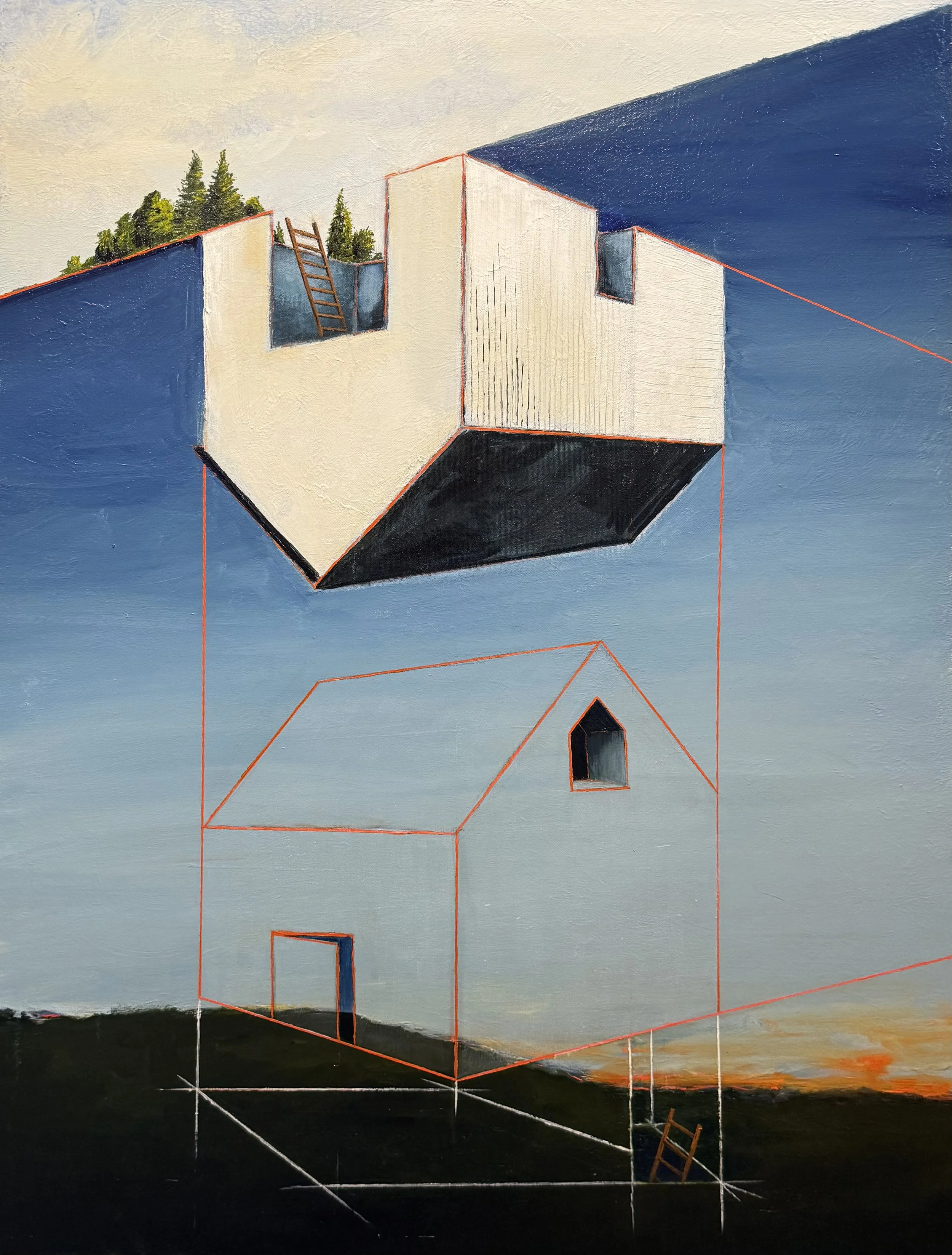
Image Shot at Buvette